Behind SARB's Rate Pause: Why South Africa's Interest Rate Policy Favors Cape Town Property Investors | DingYao
2026-06-03 8 min read Scott Huang Property Investment
In June 2026, the South African Reserve Bank (SARB) Monetary Policy Committee (MPC) made a pivotal decision: holding the repo rate at 7.75%, formally ending a multi-year hiking cycle. What does this mean for the Cape Town property market? For investors holding foreign currency and considering overseas property, a pause at the top of the rate cycle precisely creates the best entry window — local buyers remain constrained by 13-14% mortgage rates, while the negotiating advantage of international cash buyers is widening.

SARB's Rate Shift: From Hiking to Pause
SARB began its hiking cycle in 2021, raising the repo rate from 3.5% to 7.75%. In May 2026 the MPC decided to hold rates steady, signaling a formal policy shift — the market expects a rate-cutting cycle to begin in the second half of the year. Meanwhile, South Africa's inflation rate has fallen from a 2022 peak of 7.8% to around 3.8%, creating room for rate cuts.
For the Cape Town property market, this turning point has a dual meaning: first, a rate pause means mortgage costs have peaked and local buyer confidence will gradually recover, though it has not yet translated into purchasing behavior; second, before rate cuts actually arrive, international cash buyers still enjoy the largest negotiating gap relative to local mortgage buyers — this is precisely the golden window for overseas investment.
How the Rate Environment Is Reshaping Cape Town's Property Landscape
The Local Buyer Dilemma: High Rates Curb Purchasing Power
South Africa's mortgage rates currently sit in the 13-14% range, meaning a local buyer borrowing R 1,000,000 pays approximately R 130,000-140,000 in annual interest. This burden has pushed a large number of first-time buyers out of the market while suppressing local upgrade demand. Data shows that new mortgage approvals in South Africa fell 12% year-on-year in Q1 2026, while cash transactions for premium properties in the Western Cape rose to 38%.
This imbalance is directly reflected in Cape Town's market dynamics: on the supply side, local buyers are exiting the premium market; on the demand side, international cash buyers are filling the void and gaining greater negotiating room. In core areas such as the Atlantic Seaboard and V&A Waterfront, cash buyers can already secure an additional 5-10% negotiating discount — something almost impossible during periods of rate normalisation.
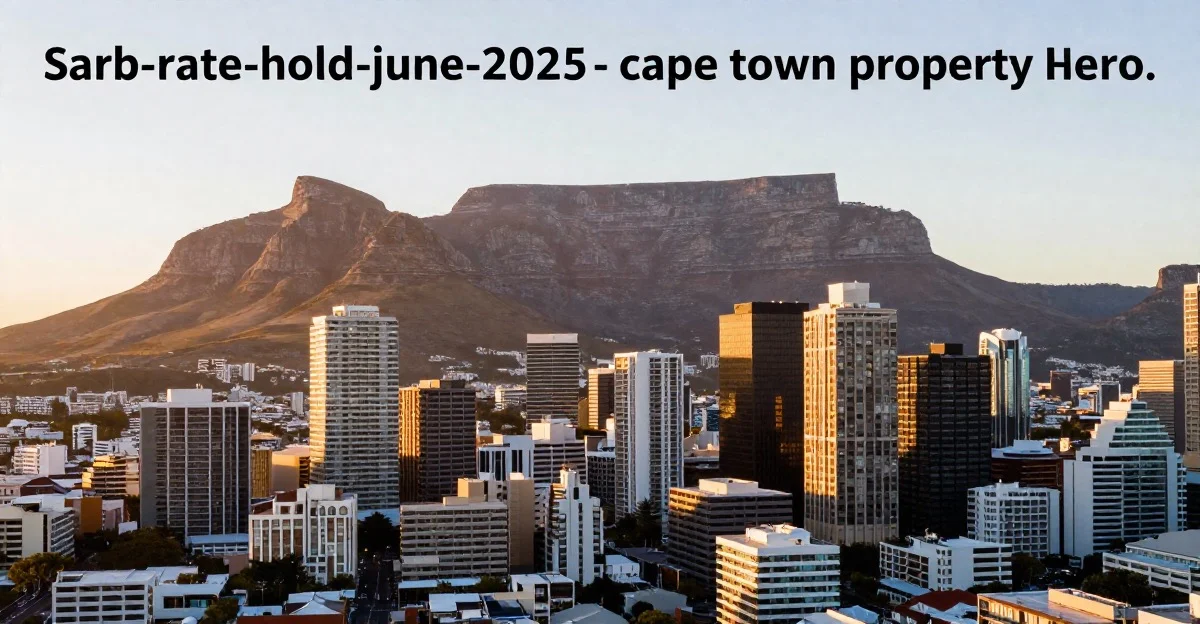
The Cape Town Atlantic Seaboard and V&A Waterfront are core areas where international cash buyers enjoy the greatest negotiating room
International Tenant Market: Rate-Insensitive Demand Supports Rents
Cape Town's premium rental market has a unique rate-insensitive characteristic, because its tenant base is largely composed of multinational corporate expatriates, international students, and medical tourists. These groups' rental capacity depends on their home-country salaries and is largely unrelated to local South African rates.
SARB data shows that rental yields in Cape Town's premium areas (Atlantic Seaboard, V&A Waterfront, City Bowl) remain stable at 8-10%, with vacancy periods of only 2-4 weeks. Even in a high-rate environment, international tenant demand continues to support rental pricing, giving landlords greater negotiating leverage.
The Interest-Rate Arbitrage Logic of Cash Buyers
For international investors, South Africa's high-rate environment creates multiple arbitrage opportunities:
Exchange-Rate Discount Stacked on Rate Advantage
ZAR/USD sits around 18:1, versus a historical average of 14:1, giving foreign-currency buyers approximately 28% additional purchasing power. Standard Bank Wealth's savings account offers 6.5% daily-compounded interest paid monthly — extremely rare in a global rate-cutting cycle.
Pricing Power Gap Between Cash and Financing
Local buyers are constrained by 13-14% mortgage rates, while cash buyers can secure an additional 5-10% discount. On a R 10,450,000 property, a 5% discount is a direct saving of R 522,500.
Dual-Engine Cash Flow Decoupled from Rates
The rental engine relies on the international tenant market, while the interest engine relies on the Standard Bank Wealth savings rate — both are decoupled from local mortgage rates, delivering annual cash flow of R 1,171,000-1,380,000.
DingYao Phase 1: The Optimal Entry Structure for a Rate Turning Point
DingYao Phase 1, with an R 16,000,000 entry threshold, is designed specifically for overseas investors, structuring a dual-engine framework that hedges interest-rate risk:
Allocation Item
Amount (R)
Description
Property Purchase Price
R 10,450,000
Premium-area property in Cape Town
Related Costs
Approx. R 550,000
Transfer, legal, trust establishment, etc.
Deposit After Handover
R 5,000,000
Standard Bank Wealth savings account
Total
R 16,000,000
Complete entry threshold
Dual-Engine Cash Flow Breakdown:
1Rental engine: R 10,450,000 × 8-10% fully-let income = annual rent of R 836,000 - 1,045,000 (income only when let; not a guaranteed fixed proportion)
2Interest engine: R 5,000,000 × 6.5% daily-compounded, paid monthly ≈ annual interest of R 335,000+ (effective annual rate approx. 6.72%)
★Total annual cash flow: R 1,171,000 - 1,380,000
Even more noteworthy is the hidden engine — interest earned during the waiting period. The full R 16,000,000 begins accruing interest as soon as it sits in the trust account, at roughly R 86,000 per month (about R 2,849 per day), so clients' capital is never idle from day one.
How the Rate Environment Aligns with the DingYao Structure
Rate Environment Feature
DingYao Phase 1 Advantage
Calculation Example
Repo rate 7.75%
Standard Bank Wealth 6.5% daily-compounded interest, paid monthly
R 5,000,000 × 6.72% ≈ R 336,000+/year
Mortgage rate 13-14%
Cash buyers negotiate an additional 5-10%
R 10,450,000 × 5% = R 522,500 saving
Rental growth pressure
International tenants support premium rents
R 10,450,000 × 8% = R 836,000/year
Dual-engine combination
Rental + interest annual cash flow
R 836,000 + 336,000 = R 1,172,000+/year
Lawyer Trust Protection: A Safety Net for Capital Amid Rate Volatility
During a rate-policy turning point, capital security matters more than ever. The lawyer trust protection framework used by DingYao ensures: the entire flow of capital transfer, holding, and repatriation is supervised by practicing attorneys, fully compliant and transparent; and the full R 16,000,000 begins earning interest the moment it enters the trust account, so investors' capital is at work from day one regardless of how rates move.
Timing Your Entry Ahead of Expected Rate Cuts
Seizing today's negotiating window matters before expected rate cuts take hold
The market widely expects SARB to begin a rate-cutting cycle in the second half of 2026, targeting 6.5-7.0%. The impact of rate cuts on Cape Town property deserves careful consideration:
Rate cuts mean local buyer purchasing power recovers — property prices will face upward pressure, and the negotiating window for cash buyers will gradually narrow. At the same time, the savings rate may edge down modestly along with the policy rate, but the current 6.5% savings rate still offers significant advantages against a backdrop of global rate cuts.
In other words, now is the optimal moment when the "negotiating dividend" from high rates and the "capital appreciation" from expected rate cuts converge. Overseas investors who wait until rate cuts actually land will miss both the negotiating edge and the chance to enter at lower prices.
Why Cape Town Property Outperforms Other Markets in Rate Resilience
The resilience Cape Town's property market has shown through rate volatility stems from three structural advantages:
1International tenant support: more than 40% of premium rental demand comes from overseas talent, decoupling rental income from local rates
2High cash-transaction ratio: cash transactions for premium properties reach 38%, so incremental demand from rate cuts translates directly into price support
3Supply scarcity: developable land in the Atlantic Seaboard and V&A Waterfront is nearly saturated, and supply-demand imbalance structurally underpins prices
These three characteristics keep Cape Town property on a positive trajectory through rate changes — in a rising-rate cycle cash buyers gain negotiating leverage, and in a cutting cycle supply-demand imbalance drives capital appreciation. For overseas investors, Cape Town offers a highly predictable investment thesis regardless of the direction of rates.
Conclusion
SARB's decision to pause rate hikes marks South Africa's interest-rate environment entering a turning point. For overseas investors, this turning point is not a risk but an opportunity: the cash-negotiation advantage brought by high rates, the dual arbitrage of exchange-rate discount stacked on high-rate savings, and the capital appreciation potential under expected rate cuts are all converging in Cape Town simultaneously. DingYao Phase 1, with its transparent R 16,000,000 entry structure, dual-engine annual cash flow of R 1,171,000-1,380,000, and full compliance protection through lawyer trust custody, offers overseas investors a complete pathway from rate analysis to tangible returns. Seizing today's negotiating window before expected rate cuts take hold is essential.

Scott Huang
Business Development — Specializing in Cape Town premium property investment and cross-border wealth management for Asia-Pacific high-net-worth individuals.
Start Your Cape Town Property Journey
Schedule a one-on-one consultation with our team to explore premium investment opportunities in Cape Town's most resilient markets.