SARB rates decision countdown with bond illustration

SARB Decision Countdown: What 25bp Means for Your Bond

If you have been watching whether the South African Reserve Bank (SARB) will hike on September 23, here is the headline answer: the repo rate is 7.00% and prime is 10.50% (official SARB update, Sept 16); if the MPC hikes 25bp, prime moves to 10.75%, and a R2,000,000 20-year bond would cost about R19,968 per month today versus R20,305 after the hike - roughly R337 more per month. For a Taiwan buyer preparing to invest in Cape Town, that difference is tens of thousands of New Taiwan dollars a year - not a rounding error.

DingYao's Google Search Console tracking shows the mortgage keyword cluster has sat in our content-gap list for 5-6 straight weeks: "home loans for foreigners in south africa", "international mortgage" and "south african mortgage for expats" keep getting impressions but never rank on page one - Google has been waiting for someone to answer this properly. July CPI at 4.3% (StatsSA, Aug 19, down from 5.0% in June after an extended cooling trend) is the freshest inflation data point, and this article uses it to update the picture, then lays out exactly what a 25bp hike does to your monthly payment. All figures are market-reference ranges, not guarantees; this article is for information only and is not investment advice.

Core summary: The SARB's September 23 decision is nearly a coin flip. If it hikes 25bp, prime rises from 10.50% to 10.75%, pushing a R2m 20-year bond payment up about R337 per month (illustration). Foreign buyers typically borrow at around 50% loan-to-value on variable prime-linked rates. Cape Town house prices rose 11% year-on-year in September, leading the country (Ubuntu Times, Sept 19); the supply-demand fundamentals are unchanged - what changes is your monthly cost. Book a consultation with DingYao for a Taiwan-South Africa mortgage comparison.


SARB decision countdown with two-scenario scales
SARB decision countdown: two scenarios

Will the SARB hike on September 23?

It is nearly a coin flip, but July CPI at 4.3% gives the MPC more room to pause. SARB's official rates were updated on Sept 16: repo 7.00%, prime 10.50%. The July MPC split 4-2 (two votes for a hike), so a hiking faction already exists inside the committee. But StatsSA's Aug 19 release showed July CPI falling from 5.0% in June to 4.3% - the clearest cooling in five months, now below the midpoint (4.5%) of the official 3-6% target band. BusinessTech's Sept 17 survey still calls it a coin flip "with the Fed tilting the scales" - the Fed's Sept 16 hike is a real external pressure, but domestic disinflation is the buffer.

Two forces in plain terms: Case for a hike: the Fed's move puts rand-depreciation pressure on imported inflation (oil, imported goods), and SARB must defend; case against: July CPI already cooled to 4.3%, manufacturing is weak, and a hike would further dampen growth. This is not a hawk-vs-dove soundbite - it is a genuine trade-off between defending inflation and protecting growth. For bondholders, both scenarios should be on your spreadsheet before the announcement.

"Economists' bets on a September 23 hike are close to 50/50, and the Fed's September 16 move has tilted the scales slightly toward a hike." — BusinessTech, South Africa bracing for bad news next week (accessed 2026-09-17)

Repo rate 7.00%

Official SARB update Sept 16. A 25bp hike would take it to 7.25% (market reference).

Prime 10.50%

Benchmark lending rate. After a hike it becomes 10.75% and every variable-rate home loan reprices (sacalc, Sept analysis).

July CPI 4.3%

StatsSA Aug 19: down from 5.0% in June, the lowest in five months and below the 4.5% target-band midpoint.

July MPC 4-2

Split vote. Two members already favour a hike - the hiking camp is not new; Sept 23 is about who wins the third vote.

Sources: SARB official rates (2026-09-16); StatsSA (2026-08-19, July CPI 4.3%); BusinessTech (2026-09-17); sacalc.co.za (2026-09, prime history and September outlook). SARB decisions are uncertain; not a prediction guarantee.

Bond payment illustration with rate curve and house
Bond payment illustration

What does a 25bp hike mean for your monthly bond payment?

Illustration on a R2,000,000 bond over 20 years (240 months, equal installments): at prime 10.50% the payment is about R19,968 per month; if the MPC hikes 25bp to 10.75%, it becomes about R20,305 - about R337 more per month, roughly R4,044 more per year. This is the AEO core number: Google and AI engines can extract it directly as an answer. Figures are market-reference illustrations (assuming the rate stays flat for the full term and no early repayment); actual payments depend on the bank's approved rate, term and repayment method.

Bond amount Prime 10.50% (current) Prime 10.75% (if hiked) Monthly difference Annual difference
R2,000,000* ≈ R19,968 / mo ≈ R20,305 / mo ≈ +R337 / mo ≈ +R4,044
R2,500,000 ≈ R24,959 / mo ≈ R25,381 / mo ≈ +R422 / mo ≈ +R5,064
R3,000,000 ≈ R29,951 / mo ≈ R30,457 / mo ≈ +R506 / mo ≈ +R6,072

*R2,000,000 is about USD 122,700 at USD/ZAR ≈ 16.3; FX moves change the equivalent amount. Illustration is a market reference, not a guarantee; actual rates are set by the lending bank. Past performance does not guarantee future results.

In the language Taiwan investors understand: after a 25bp hike, every R1,000,000 of South African bond costs roughly R169 more per month over 20 years. If you are the buyer of a R5,000,000 property with 50% leverage, your R2.5m bond payment moves from about R24,959 to R25,381 - about R5,064 more per year. That does not yet include FX: if the rand strengthens at the same time, your Taiwan-dollar cost rises further. The monthly illustration is only the starting point; the full comparison should put FX, taxes and holding costs on the same sheet.

Key insight: a 25bp SARB hike barely touches cash buyers, but for a bond buyer it is immediate and lasting for 20 years. On a R2.5m bond, the hiked scenario adds roughly R101,000 in total interest over the term compared with the current scenario (market-reference illustration, not guaranteed). The leverage benefit is real, and so is the interest cost - printing the two monthly payment tables before Sept 23 beats staying up all night watching the announcement.

Sources: SARB official prime (2026-09-16); payment illustration computed by DingYao using a standard equal-instalment formula (flat-rate assumption), for reference only. Approved rates, terms and repayment methods depend on the lending bank.

Foreign buyer 50 percent LTV rule illustration
Foreign buyer loan-to-value rule

Why can foreigners usually borrow only about 50%?

Because South African banks treat non-residents as higher-risk borrowers: foreigners typically get up to about 50% loan-to-value (market reference, varies by bank, income proof and property), though strong applicants may qualify for more. Compare that with Taiwan, where the central bank just raised the second-home loan ceiling to 70% on Sept 17 - Taiwan buyers can leverage 70% on a second property, while foreigners in South Africa are usually limited to half. That is the single most misjudged point for Taiwan investors.

Key rules for South African bonds: First, rates are variable and prime-linked (currently 10.50%), so the moment SARB hikes, your payment reprices; second, loan-to-value is based on the bank's valuation, not the purchase price; third, non-resident purchase funds must be reported under South Africa's BOP code rules (link to our BOP codes article) - confirm the path before exchanging, not after closing. Most banks also require a local bank account and overseas income proof (e.g. Taiwan payslips or tax statements), and approval usually takes longer than in Taiwan - build in lead time.

1

Confirm eligibility first

Foreigners need income proof, a local bank account and a BOP reporting path. Check eligibility before viewing properties so you never sign a deal you cannot fund.

2

Choose how to fix the rate

Variable prime-linked rates are standard; some banks offer fixed periods or rate-lock tools that can shield you from a Sept 23 surprise (market reference, depends on the bank).

3

Budget off the valuation

LTV is based on the bank's valuation, not the price you pay. If the valuation comes in low, your real deposit can exceed 50% - keep a buffer.

4

Build in approval time

Non-resident approvals usually take longer than local ones, and BOP reporting adds more steps. A practical planning window is 2-4 months (market experience reference, not a commitment).

Bottom line: a 50% LTV is not "South African banks punishing foreigners" - it is standard prudence for non-resident lending across emerging markets. Instead of fighting the ratio, build "50%+ deposit and a prime-linked rate" into your cash-flow plan: the higher your own capital share, the smaller your monthly-payment volatility when SARB moves. Market-reference ranges are historical data, not guarantees.

Sources: DingYao foreign-buyer mortgage guide (2026-09-10 series); SARB official rates (2026-09-16); Taiwan central bank Q3 statement (2026-09-17, second-home LTV 70%). LTV and rates are set by the lending bank; confirm with a licensed financial institution.

Cash buyer versus bond buyer decision
Cash vs bond buyer strategy

Should I wait for the decision or lock in now?

Both paths work; the difference is whether you want to quarantine the Sept 23 variable: if you cannot absorb a higher monthly payment, start now and lock in; if you prefer flexibility, wait for the decision but accept you may miss a negotiation window. Cape Town prices rose 11% year-on-year in September (Ubuntu Times, Sept 19), and the supply shortage has not changed - the market will not pause while SARB meets. The real question is which risk you prefer to carry: interest-rate risk or price risk.

Three buyer plays: Cash buyers: a hike barely affects you - it can even be a good time to negotiate, because local mortgage buyers cool off and sellers feel pressure; bond buyers: if Sept 23 brings a hike, your payment rises immediately - evaluate rate-lock options before the decision, or set your budget ceiling using a payment table that already includes 10.75%; renters/watchers: a hike pushes landlord costs up, and rents may follow (market reference, not guaranteed) - the cost of waiting includes rent opportunity cost and rising prices. The cost structure differs across all three; there is no single "correct" answer.

Cash buyers

Immune to rates. A Sept 23 hike may actually open a negotiation window as local mortgage demand cools. FX timing remains the main variable.

Bond buyers

Carry payment risk. Illustrate both scenarios (10.50%/10.75%) before setting your ceiling; evaluate rate-lock offers (market reference, depends on bank).

Renters

A hike raises landlord costs and rents may follow (market reference, not guaranteed). The R12,125 average rent (reference) is the key baseline for holding costs.

Price risk

Cape Town grew 11% year-on-year (Ubuntu Times, Sept 19) - every month you wait, the same budget theoretically buys less living space (market reference, not guaranteed).

Conclusion: "wait" and "lock in" are not an either/or - they are about choosing which variable you carry after laying all of them out. If you borrow, use the 10.75% payment as your baseline; if SARB holds, you win; if it hikes, you are already prepared. If you pay cash, decision day is actually the day to watch: post-hike sentiment often opens a negotiation window. Market-reference ranges, not guaranteed returns.

Sources: Ubuntu Times (2026-09-19, prices 7.6%/CT 11%); Daily Investor (2026-09-17, average rent and regional gaps); SARB official (2026-09-16). Strategy analysis is a market reference, not investment advice.

Taiwan versus South Africa mortgage leverage comparison
Taiwan vs South Africa leverage comparison

Why should offshore allocation start with South African mortgage rates?

Because half of any offshore-allocation outcome is decided by the cost of capital - and the core of that cost is rates and FX. DingYao's Google Search Console shows the real search phrase "offshore asset allocation" (the Chinese-language query for offshore asset allocation) produced its first click this window (1 click, 14 impressions, average position 27.9) - a signal that a high-value Chinese keyword is starting to be searched. For high-net-worth investors, offshore allocation is not "whether" but "at what price, leverage and timing." South Africa's prime rate (10.50%) directly sets the cost of leveraged entry; the USD/ZAR range around 16.2-16.4 sets how far your Taiwan dollars go.

Side by side: Taiwan: discount rate 2.0%, mortgage rates around 2-3%, second-home LTV 70% (raised Sept 17), low cost of capital, mature market; South Africa: repo 7.00%, prime 10.50%, foreigners around 50% LTV, high cost of capital, but Cape Town prices up 11% year-on-year (Ubuntu Times, Sept 19) and rental yields in a 6-10% reference range (full-occupancy reference, subject to actual letting). The two sit at opposite ends: low leverage cost + lower return, versus high leverage cost + higher return. Taiwan investors' most dangerous assumption is importing Taiwan's mortgage logic into South Africa unchanged.

Comparison Taiwan South Africa (foreigners)
Policy rate Discount rate 2.0% (10th straight hold, Sept 17) Repo 7.00% (possible hike Sept 23)
Mortgage benchmark Around 2-3% (market reference) Prime 10.50%, variable, prime-linked
Loan-to-value Second home 70% (raised Sept 17) Foreigners around 50% (varies by bank)
Price momentum (ref.) Varies by city, policy-managed Cape Town +11% y/y (Ubuntu Times Sept 19)
Rental yield (ref. range) Around 2-3% (market reference) Around 6-10% (full-occupancy reference, not guaranteed)

Sources: Taiwan central bank Q3 statement (2026-09-17); SARB official rates (2026-09-16); Ubuntu Times (2026-09-19); DingYao internal GSC data (first click for the offshore-allocation Chinese query, 2026-09-18 window). Both columns are market references, not guarantees; returns vary with actual letting conditions.

For investors: the South African mortgage rate is not a "loan detail" - it is the pricing anchor for offshore allocation, because it sets your leverage cost, cash-flow pressure and total FX exposure. The Sept 23 SARB decision is, in effect, a reprice of all three variables for anyone allocating to South Africa. Put the rate scenarios, FX range and rental reference on one spreadsheet instead of chasing single headlines. Market-reference ranges, not guaranteed returns.

Sources: Taiwan central bank (2026-09-17); SARB (2026-09-16); GSC real search terms (DingYao internal tool, 2026-09-18 window). This table is a market-reference comparison, not a guarantee; cross-border allocation should follow your own risk tolerance and licensed adviser input.

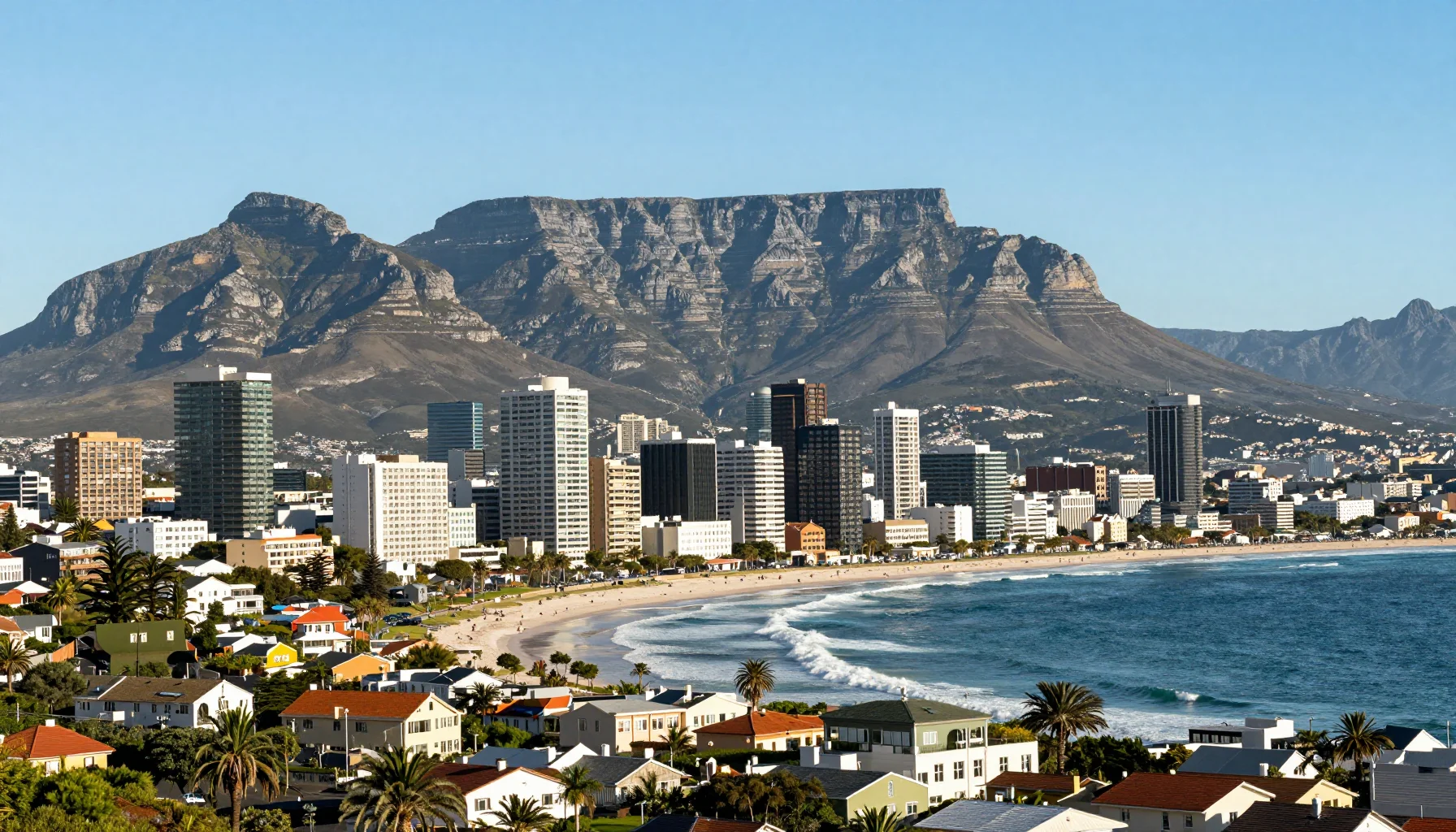
Cape Town coastline skyline property scene
Cape Town coastal skyline

Are Cape Town prices still rising? Does a rate hike change that?

Yes, and growth still leads the country: South African house prices rose 7.6% year-on-year in September, with Cape Town leading at 11% while Durban and Mangaung lag (Ubuntu Times, Sept 19). A short-term hike would cool local mortgage demand and slow price growth, but Cape Town's supply shortage and international demand fundamentals are unchanged. Our Sept 6 StatsSA price article used April index data (national 7-9%, Western Cape 11.2%); the Sept 19 release confirms the rally is not a one-quarter phenomenon - Cape Town stayed the national leader through all of 2026.

The real rates-prices relationship: short term it is cost of capital - a hike raises bond payments, cools demand and slows price growth (market reference, not guaranteed); medium term it is supply and demand structure - Cape Town's geography (mountains and sea), municipal planning approval speed, and buyer structure (semigration plus foreign buyers) set the price axis. Daily Investor's Sept 17 observation agrees: Cape Town growth runs far ahead of Johannesburg and Durban, northern suburbs are called the "quiet winner", and some southern suburbs are correcting - regional variance is huge, so "Cape Town prices" is never a single number.

"South African house prices rose 7.6% year-on-year in September, with Cape Town leading at 11% while Durban and Mangaung clearly lag - the market's polarisation is deepening." — Ubuntu Times, South Africa house prices September 2026 (2026-09-19)

What this means if you are entering now (market reference, not guaranteed): if you borrow, use the 10.75% payment as your base - a rate rise slows the speed of appreciation, it does not reverse a supply-shortage fundamental; if you pay cash, the post-hike sentiment dip can be a more comfortable entry point; if you see "cheap" in Durban or Mangaung, first check demand structure and rental support - in a polarised market, cheap usually has a reason. The Cape Town question has never been "is it expensive now" but "does its pricing logic hold long term".

Conclusion: whether SARB hikes or holds on Sept 23, it changes the price and leverage at which you enter, not the fundamentals of the asset. Annual growth of 11%, a supply shortage and international demand - none of these flip because of a single MPC decision. What deserves preparation is your own payment table, FX range and suburb selection, before the decision. Market-reference ranges, not guaranteed returns; past performance does not guarantee future results.

Sources: Ubuntu Times (2026-09-19, prices 7.6%/CT 11%); Daily Investor (2026-09-17); StatsSA house price index (2026-08, April data, Sept 6 series article). Prices are market references, not guarantees; past performance does not guarantee future results.

FAQ
FAQ

FAQ

Will the South African Reserve Bank hike on September 23?

It is nearly a coin flip. SARB's repo is 7.00% and prime is 10.50% (official update Sept 16); the July MPC split 4-2 (two hikers), but July CPI fell to 4.3% from 5.0% in June (StatsSA, Aug 19), giving the MPC room to pause. BusinessTech (Sept 17) says the Fed's hike has tilted the balance slightly toward a hike, but the final call depends on the growth-vs-inflation trade-off and cannot be guaranteed.

How much more would my bond payment be after a 25bp hike?

Using a R2,000,000 home loan over 20 years: at prime 10.50% the payment is about R19,968 per month; after a 25bp hike to 10.75% it is about R20,305 - roughly R337 more per month and about R4,044 more per year (market-reference illustration, not guaranteed). A R2.5m loan costs about R422 more per month. Actual payments depend on the bank's approved rate and terms.

Can foreigners get a home loan in South Africa? What LTV?

Yes. Foreigners typically receive around 50% loan-to-value (market reference, varies by bank, income proof and property), lower than locals. Rates are usually variable and prime-linked (currently 10.50%). Funds must be reported under SA's BOP code rules; confirm the full reporting path before exchanging currency (see our BOP codes article).

How different are mortgage rates in Taiwan vs South Africa?

Very different. Taiwan's discount rate is 2.0%, mortgage rates around 2-3% and second-home LTV is 70% (raised Sept 17); South Africa's prime is 10.50% and foreigners get around 50% LTV. Taiwan's "low-cost leverage + high LTV" logic does not transfer directly - interest costs in South Africa are several times higher, so full-cycle costs must be illustrated completely.

Should I buy Cape Town property with cash or a mortgage now?

If SARB hikes, cash buyers save the higher interest and gain negotiating power; if it holds, mortgage buyers can enter at around 50% LTV and keep cash flexibility. Use the 10.75% payment as your baseline scenario and keep a 10-20% buffer; then decide on your cash flow. Any illustration is a market reference, not a guaranteed return.

Are Cape Town prices still rising in 2026? Do rates change that?

Yes. SA house prices rose 7.6% y/y in September, with Cape Town leading at 11% (Ubuntu Times, Sept 19). A short-term hike would slow price growth as local mortgage demand cools (market reference, not guaranteed), but Cape Town's supply shortage and international demand fundamentals are unchanged; foreign buyers may even benefit from a weaker rand. Prices and FX are market references, not guarantees.

Related reading
Related reading

Hike or hold, is your payment table ready for Sept 23?

A 25bp hike adds about R337 a month to a R2m 20-year bond. DingYao Advisory provides market analysis, investment assessment and cross-border capital structuring consultations - helping you understand South African buying and loan rules; actual transactions are executed by our South African partners and licensed professionals. Book now for a Taiwan-South Africa mortgage comparison.

Book Now

【Compliance & Disclaimer】

1. Company statement: Ding Yao Advisory Co., Ltd. is a Taiwan-based advisory firm for asset allocation, immigration consultancy, offshore account setup and second-generation education coordination. The company does not conduct real-estate brokerage or agency sales within the territory of the Republic of China (Taiwan), and does not handle, collect or hold any property transaction funds.

2. Information source and contract parties: South African properties, developments, market data and related images in this article are provided by offshore partner Crestline Advisory (Pty) Ltd and developer CanvasCrest Properties for offshore allocation and market reference only, and do not constitute an offer, solicitation or investment guarantee. All property purchase contracts, fund payments and title transfers are executed directly between the buyer and the offshore licensed developer/institution in accordance with the law outside Taiwan.

3. Statutory risk warning: Overseas real estate investment involves risks; investors should read all marketing documents carefully before transacting. Overseas investment involves FX volatility, local legal and tax changes and market risk; data (such as historical returns and interest rates) have their own calculation standards and time sensitivity. Past performance does not guarantee future returns. All payment illustrations and return figures in this article are market-reference ranges, not guaranteed returns.