
> >
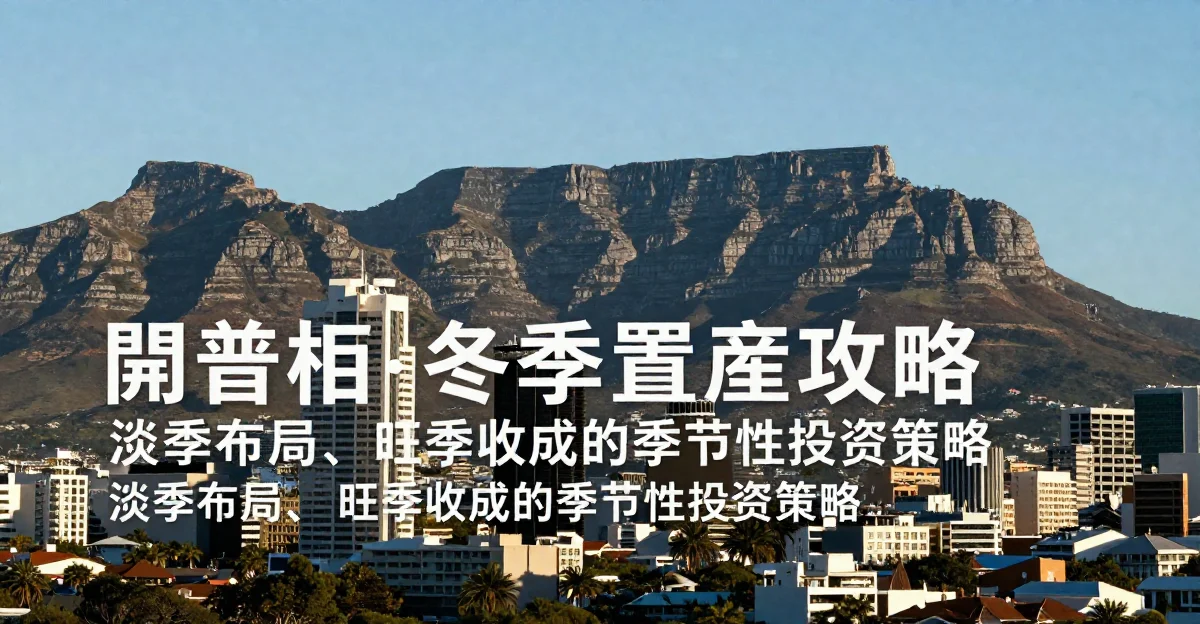
Cape Town Winter Property Guide

Cape Town Winter Property Guide: A Seasonal Investment Strategy — Position in the Off-Season, Harvest in the Peak Season | DingYao Advisory

Cape Town’s Seasonal Market Rhythm

The Cape Town property market can be divided into four strategic phases across the year:

  • 1 Winter (June-August): The traditional off-season, when sellers are eager to sell and negotiation room in prime areas can reach 3-8%. This is the most relaxed bargain-hunting window for overseas investors.
  • 2 Spring (September-November): The market warms as international buyers return and competition gradually intensifies.
  • 3 Summer (December-February): The peak season, when tourism rental demand lifts rental yields but compresses negotiation room.
  • 4 Autumn (March-May): A steady transition period, well suited to adjusting holding strategies.

According to Seeff’s market reports, premium Cape Town properties (in areas such as V&A Waterfront and the Atlantic Seaboard) listed during winter typically reflect urgent sale needs driven by semigration or job relocations, and sellers are far more willing to accept reasonable offers than in summer. Property24 data likewise shows average sale prices between June and August carry 3-5% discount room compared with the peak season — precisely the entry point for astute investors.


The Hidden Advantages of Off-Season Negotiation

The core advantage of entering in winter lies not only in price, but in the breadth of choice:

1. Greater Negotiation Room

With relatively ample supply and subdued demand, sellers in winter are more willing to accept well-structured offers. On the Atlantic Seaboard and around V&A Waterfront, off-season negotiation room can reach 3-8% — meaning a quality property priced at R 10,450,000 could close with a discount of R 960,000 to R 830,000 during winter.

2. The Tech-Tenant “No Off-Season” Effect

Cape Town’s technology ecosystem is rewriting the traditional seasonal pattern. Tech giants such as Amazon, Microsoft, and Google have established operations in Cape Town, drawing international remote workers to relocate year-round. Rental demand in tech hubs like Claremont and Sea Point fluctuates far less seasonally than in purely tourist areas, giving winter entrants a stable source of tenants.

3. The Real Value of a Winter Inspection

Cape Town’s winter (June-August) averages about 7-17°C, far more liveable than many investors imagine. A winter inspection reveals the true quality of daily life — routine commutes, grocery shopping, and community activities outside the tourist season — real-world information a summer sightseeing trip simply cannot provide.

Cape Town dual-engine investment structure
The dual-engine structure keeps capital working from day one — the interest engine begins operating during the winter viewing period

The Dual-Engine Configuration for Counter-Seasonal Investing

The dual-engine architecture of the DingYao Phase 1 South Africa programme is naturally suited to a “position in winter, harvest in peak season” strategy:

Investment threshold: R 16,000,000

Item Amount Description
Property purchase price R 10,450,000 Curated property in a prime Cape Town area
Related costs Approx. R 550,000 Transfer, legal, and trust formation
Standard Bank Wealth savings R 5,000,000 6.5% daily-compounded, paid monthly

Dual-engine annual cash flow:

  • Rental engine: R 10,450,000 × 8-10% = R 836,000 - R 1,045,000/year (full-occupancy income; income only when tenanted)
  • Interest engine: R 5,000,000 × 6.5% daily-compounded, paid monthly ≈ R 335,000+/year (effective annual rate of approx. 6.72%, compounding included)
  • Combined annual cash flow: R 1,171,000 - R 1,380,000

The key advantage of entering in winter: the R 5,000,000 savings balance begins accruing interest from the very first day it enters the trust account, earning roughly R 86,000/month (about R 2,849/day). Even before the property settles during the winter viewing period, the interest engine is already running — the client’s money never sits idle from day one.

Legal Trust Protection: A Safety Net for Remote Execution

For overseas investors, the greatest concern about positioning in winter is: “If I am not on the ground, how can I transact safely?”

The legal trust protection mechanism DingYao employs is precisely the key to resolving this pain point:

Capital Safety

The full investment of R 16,000,000 is remitted into a trust account held by a practising South African attorney, strictly governed by South African law and inaccessible without client authorisation.

Document Protection

All property transaction documents are reviewed by attorneys to ensure clear title and full legal compliance.

Remote Execution

Investors never need to fly to South Africa; the legal team can handle the full scope of matters — due diligence, title transfer, and rental management — on their behalf.

Executing the “Winter Dividend” Strategy

Cape Town’s seasons are the opposite of the northern hemisphere, creating a unique “winter dividend” for overseas investors:

The Four-Step Winter Dividend Playbook

1

Winter Inspection & Screening (June-August)

Commission the DingYao professional team to view properties on the ground, or experience Cape Town’s real winter quality of life yourself. Screen quality properties in prime semigration zones. Negotiation room is at its widest and terms at their most favourable.

2

Spring Transaction Close (September-November)

Complete the transfer under the legal trust protection mechanism. Allocate R 5,000,000 to a Standard Bank Wealth savings account, activating the interest engine immediately. Launch rental management the moment the property settles.

3

Summer Harvest (December to the following February)

Peak-season rental demand lifts rental yields. A hybrid of short-term (Airbnb-style) and long-term (tech-tenant) leasing maximises returns. The annual cash-flow target of R 1,171,000 - R 1,380,000 is achieved.

4

Autumn Optimisation (March-May)

Review leasing performance and adjust the tenant mix. Assess appreciation potential and consider increasing exposure in the next tranche.

Comparison: Cape Town vs Other Overseas Investment Markets

Comparison Cape Town London Dubai Singapore
Entry threshold R 16,000,000 ≈R 50M+ ≈R 15M ≈R 40M+
Annual rental yield 8-10% (full occupancy) 3-4% 5-7% 2-3%
Off-season negotiation room 3-8% <2% 5-10% (off-plan) <1%
Capital safety (trust) Legal trust protection Basic protection Developer trust Basic protection
Annual cash flow (dual-engine) R 1.17M-1.38M

Conclusion

Cape Town’s winter is not a season for watching — it is a season for positioning.

Off-season negotiation room, year-round tech-tenant demand, and a seasonal rhythm opposite to the northern hemisphere — these three factors form a unique “winter dividend” for overseas investors. Combined with the DingYao Phase 1 dual-engine architecture (rental + interest), the R 16,000,000 portfolio begins generating cash flow from day one, while the legal trust protection mechanism secures every rand.

Right now is winter in the southern hemisphere — and the best time to enter the market. Consult DingYao now to master a Cape Town off-season positioning strategy.

Scott Huang

Scott Huang

Business Development — Specializing in Cape Town premium property investment and cross-border wealth management for Asia-Pacific high-net-worth individuals.

Start Your Cape Town Property Journey

Schedule a one-on-one consultation with our team to explore premium investment opportunities in Cape Town's most resilient markets.

Consultation