
> >
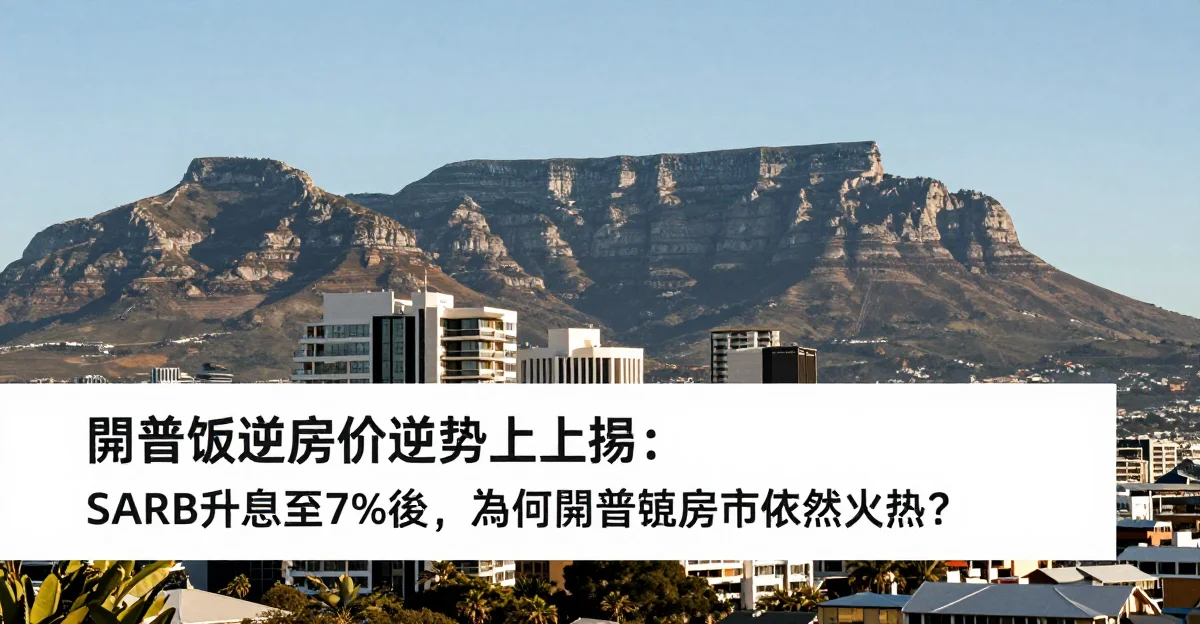
Cape Town Property Prices Defy the Trend: Why the Market Stays Hot After SARB's Rate Hike to 7%

Cape Town Property Prices Defy the Trend: Why the Market Stays Hot After SARB's Rate Hike to 7% | DingYao Advisory

Introduction: A Rate Hike Is Not a Headwind, But a Touchstone

On May 28, 2026, the SARB's Monetary Policy Committee (MPC) voted 4 to 2 to raise the repo rate by 25 basis points to 7.00%, lifting the prime rate to 10.50%. Four members supported the hike; two opposed it. Inflation forecasts were revised upward in tandem: 2026 was adjusted from 3.7% to 4.4%, and 2027 from 3.3% to 3.7%. Economic growth forecasts were revised down, with 2026 growth trimmed from 1.4% to 1.2%.

According to textbook theory, a rate hike should suppress property prices — higher borrowing costs mean fewer buyers and lower prices. But Cape Town's market data shows this rule does not apply here. In fact, the rate hike has instead become a touchstone for validating the structural resilience of Cape Town's property market: while other markets cool in response to rising rates, Cape Town's scarcity-driven growth continues unabated.
SARB Rate Hike Overview: The Logic Behind the May Decision

Details of the Hike Decision

The MPC's rate hike was not made lightly. The four members in favor were focused on the upside risks to inflation — the 2026 inflation forecast was revised up from 3.7% to 4.4%, already near the upper edge of the SARB's 3-6% target range. The two members opposing the hike argued that slowing economic growth (from 1.4% to 1.2%) calls for a more accommodative monetary policy.

The next MPC meeting will be held on July 23, 2026. Market consensus expects that if inflation data continues to exceed expectations, the SARB may raise rates further. But regardless of the direction of rates, Cape Town's structural property-market drivers appear unaffected by short-term monetary policy.

Market Reaction: Rising Mortgage Costs, But Cash Transactions Dominate

After the hike, the prime rate rose to 10.50%, meaning higher monthly repayments on variable-rate mortgages. But this impact is substantially weakened in Cape Town's premium market — because 82% of premium property transactions are cash deals (BetterBond/FNB data). For these buyers, changes in interest rates barely influence purchase decisions.

This is a defining structural feature of the market: Cape Town's premium property market is not mortgage-driven but sustained jointly by cash buyers, semigration capital, and international capital. This is what makes the traditional "rate hike → cooling" transmission chain ineffective here.

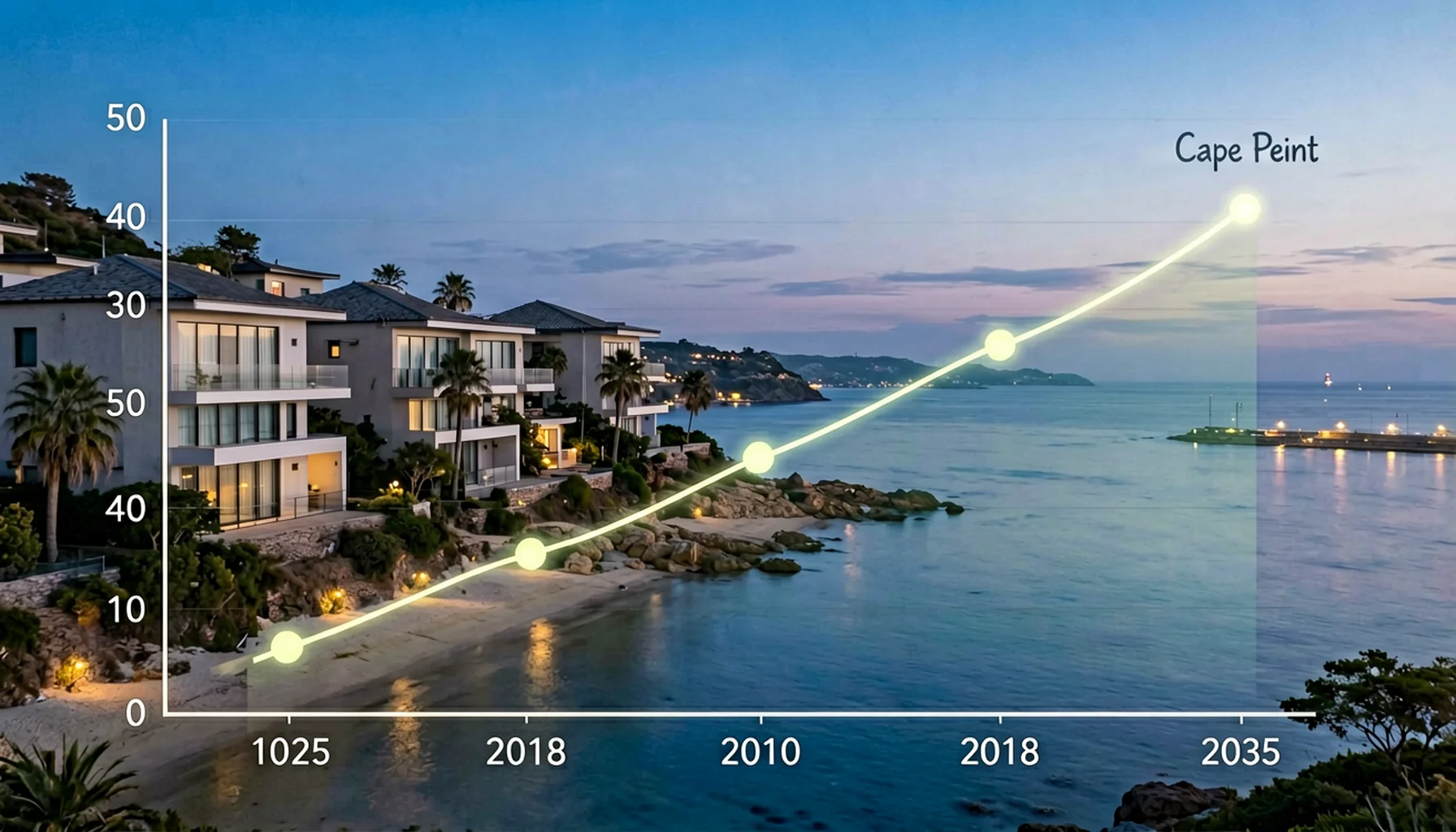
Cape Town Price Resilience Data: The Truth Behind 8-10% Annual Growth

The Africanvestor Latest Data (Updated June 19, 2026)

The Africanvestor's latest report provides a detailed picture of Cape Town's property price growth:

IndicatorData
Cape Town average price~R 2,600,000 (across all property types)
Average price per sqm~R 28,000/m²
12-month price growth**~11%** (City of Cape Town metro index)
2026 full-year forecast growth**8-10%** (range 6-12%)
5-year forecast nominal growth45-60%
10-year forecast nominal growth110-150%

Regional Growth Ranking: Where Are Prices Rising Most?

RegionAnnual Growth RateDrivers
Sea Point & Green Point**12-15%**Seafront living, international buyers, short-term rental demand
Woodstock & Salt River9-12%Urban renewal, influx of young professionals
Claremont & Rondebosch8-11%School districts, hospitals, transport hubs

Sea Point and Green Point lead the city with annual growth rates of 12-15%; these two seafront areas have long been the preferred choice of international buyers. Woodstock and Salt River have become the fastest-growing inner-city areas thanks to urban renewal and an influx of young professionals. Claremont and Rondebosch deliver steady growth, benefiting from top-quality school districts and healthcare resources.

Property Type Appreciation Ranking: Townhouses Lead

  1. Townhouse — 10-13% annual appreciation (security, parking, low maintenance)
  2. Apartment — 8-11%
  3. Condo / sectional title — 7-10%
  4. Villa — 5-8% (high price point, smaller buyer pool)

Townhouses lead all property types with annual appreciation of 10-13%. For overseas investors, this is an important signal: a Townhouse offering high security, convenient parking, and low maintenance costs is not only well-suited to remote management but also offers the greatest appreciation potential.

Why Rate Hikes Cannot Crush Cape Town: Four Structural Pillars

1. Extreme Supply Scarcity

Cape Town's geography determines its supply ceiling: bounded by the Atlantic Ocean to the west and Table Mountain National Park to the east, developable land is extremely limited. Slow municipal approvals and infrastructure constraints have reduced new supply to nearly zero. Property24 data shows that Cape Town's property inventory fell from 6,584 to 5,759 listings over the six months from December 2025 to May 2026, a decline of 12.5%.

2. Cash Transactions Dominate the Premium Market

As noted earlier, 82% of premium property transactions are cash deals. This means changes in interest rates have negligible impact on the premium market. When most buyers do not need financing, rate hikes lose their traditional cooling effect.

3. Semigration Continues to Accelerate

According to StatsSA data, roughly 319,000 people moved net into the Western Cape between 2021 and 2026, a large share of them high-net-worth professionals. BetterBond reports that the Western Cape remains the top destination for semigration, with 80% of Cape Town sellers buying again locally. These semigrants bring proceeds from selling homes in Gauteng and enter Cape Town's market with cash.

4. International Buyers Remain Confident

Cape Town's international appeal stems not only from its natural beauty and quality of life, but also from its relative price advantage. Compared with global cities such as London, New York, and Sydney, quality Cape Town property still sits in a value trough. Combined with the rand at historically low exchange rates (USD/ZAR around 18:1, versus a historical average of 14:1), international buyers enjoy an exchange-rate discount of roughly 20-30%.

The Rental Market Is Equally Strong

Yield Data

RegionYield TypeYieldSource
City Bowl 1-bedNet yield7.5-7.9%The Africanvestor (May 2026)
Northern SuburbsGross yield7-9%KiliCasa (Apr 2026)
Southern SuburbsGross yield5.5-7%SA Property Tools (Jun 2026)

The strength of the rental market provides a second layer of support for price growth: high yields mean investors can cover mortgage costs with rental income ("rent-to-mortgage") or secure stable cash-flow returns, further reinforcing Cape Town property's investment appeal.

The Time Cost for Overseas Investors: The Price of Waiting

Based on an annual growth rate of 8-10%, the entry cost of R 16,000,000 increases by R 1,280,000-R 1,600,000 for each year of waiting. This is not a theoretical figure — it is Cape Town's actual current rate of property appreciation.

For investors considering overseas property, this means time itself is a cost. The earlier you enter, the lower your entry price — and the sooner you begin accumulating rental income and property appreciation.

Phase 1 Plan: Positioning Within Growth

DingYao's Phase 1 programme offers a complete, structured investment plan:

ItemAmountDescription
Total investmentR 16,000,000Entry threshold
Property purchase priceR 10,450,000Premium Cape Town property
Associated costs~R 550,000Transfer, legal, trust setup, etc.
Post-transfer current accountR 5,000,000Standard Bank Wealth current account

Dual-engine annual cash flow:

  • Rental engine: R 10,450,000 × 8-10% = R 836,000 - R 1,045,000/year (full-occupancy income; rental income is generated only when tenanted)
  • Interest engine: R 5,000,000 × 6.5% daily-compounded, paid monthly ≈ R 335,000+/year (effective annual rate approx. 6.72%)
  • Total annual cash flow: R 1,171,000 - R 1,380,000

Combined with annual property appreciation of 8-10% (approx. R 1,280,000-R 1,600,000/year), the overall annual return is substantial.

Attorney trust protection: Overseas investors' funds are protected by South African law from day one. Before transfer of ownership, the full purchase price is held in an attorney trust account and has already begun accruing interest. Your money never sits idle — even before the property is transferred, your funds are generating returns.

Conclusion: The Rate Hike Validated Cape Town's Resilience

The SARB's rate hike is not a headwind for Cape Town's property market — it is a touchstone that validates its structural resilience. While other markets cool as rates rise, Cape Town's scarcity-driven growth continues. For overseas investors, this means two things: first, the long-term appreciation logic for Cape Town property remains firmly intact; and second, the cost of waiting is growing at R 1,280,000-R 1,600,000 per year.

Now is the time to seriously consider investing in Cape Town property.

Scott Huang

Scott Huang

Business Development — Specializing in Cape Town premium property investment and cross-border wealth management for Asia-Pacific high-net-worth individuals.

Start Your Cape Town Property Journey

Schedule a one-on-one consultation with our team to explore premium investment opportunities in Cape Town's most resilient markets.

Consultation