> >
Cape Town property 2026 outlook for overseas investors

Cape Town Property 2026 Outlook: How Overseas Investors Can Capture the 4-7% Appreciation Dividend | DingYao Advisory

Three Drivers: Why 4-7% Growth Is Sustainable

Lifestyle Migration: The Long-Term Dividend of Population Inflow

Semigration (domestic migration) is the most persistent support for Cape Town’s prices. Over the past five years, more than 10,000 households per year have relocated to the Western Cape from provinces such as Gauteng, chasing a better quality of life, lower crime rates, and more reliable municipal services. REMAX Living reports tenant growth of 11.6% — this is not speculative demand but a genuine demographic shift.

These migrants are mostly mid-to-high-income households, and their demand centres on quality homes in Atlantic Seaboard, City Bowl, and the Southern Suburbs. Supply elasticity is extremely low — Cape Town’s geographic constraints (a narrow corridor between mountains and sea) and strict zoning mean new supply can hardly increase quickly.

Supply Scarcity: Cape Town’s Geographic and Institutional Advantages

Cape Town’s supply constraint is structural, not cyclical:

  • Geographic limits: Table Mountain, the Atlantic coastline, and False Bay form natural boundaries, leaving very little developable land
  • Zoning controls: City of Cape Town zoning regulations tightly restrict high-density development, preserving existing neighbourhood character
  • Construction timelines: from planning to transfer typically takes 18-24 months, far slower than the pace of demand growth

The result is a deepening supply-demand imbalance. On the Atlantic Seaboard, days-on-market for quality properties has compressed to under 30 days, and bidding scenarios are increasingly common.

A Falling-Rate Environment: A Tailwind That Lowers the Cost of Capital

Since September 2024 the SARB has cut rates six times in a row, lowering the prime rate from 11.75% to 10.25% and the repo rate to 6.75%. The knock-on effects of these cuts are especially favourable for overseas cash buyers:

  1. Stronger local purchasing power: rate cuts reduce local buyers’ monthly repayment burden, lifting the floor under demand
  2. Relatively higher rental yields: as rates fall, the returns on fixed-income alternatives drop, making property rental yields more attractive
  3. The Standard Bank Wealth call account still pays 6.5%: compounded daily and paid monthly, with an effective annual rate of about 6.72% and annual interest of roughly R 335,000 — still competitive in a falling-rate environment
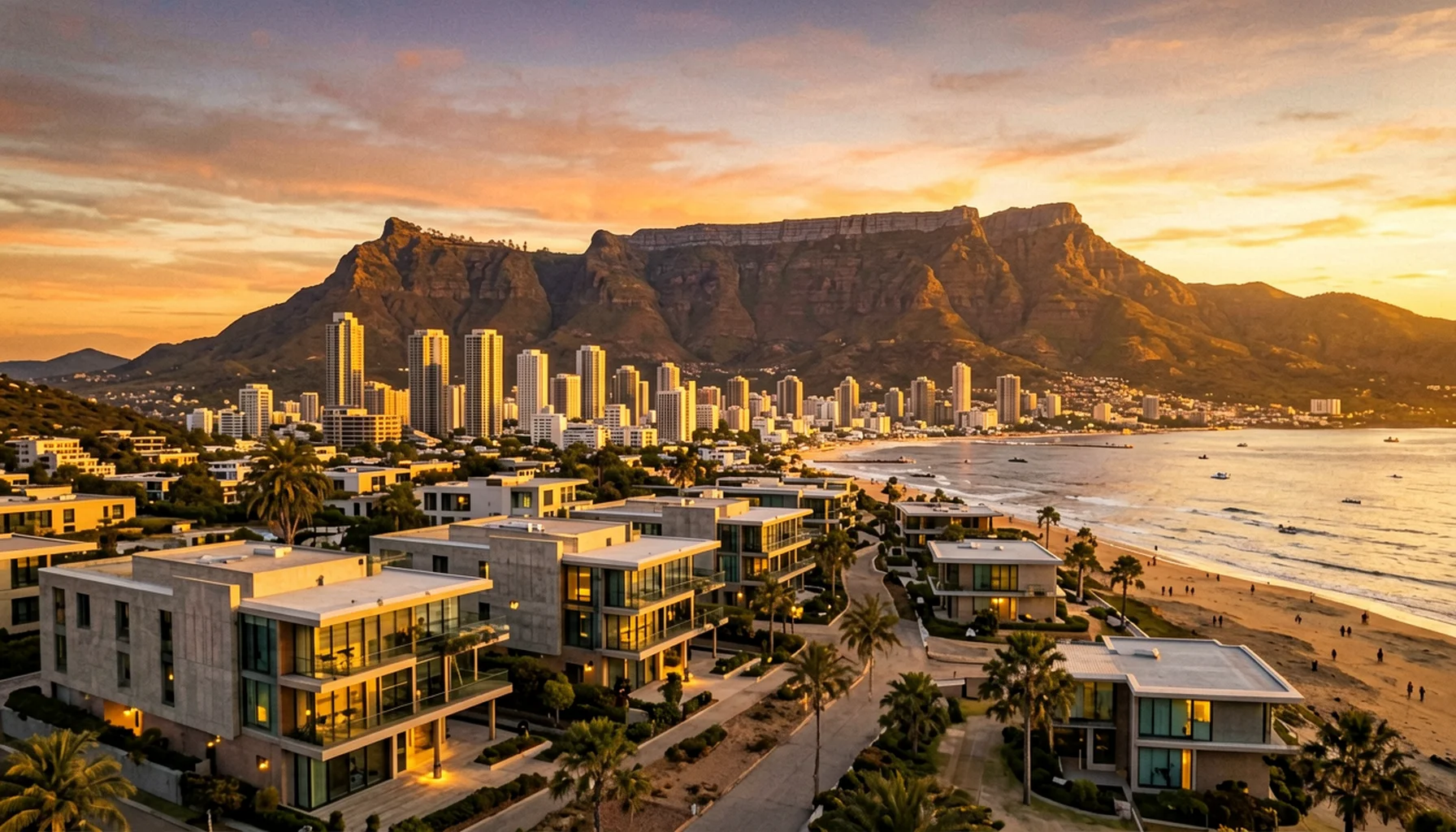
Aerial view of Cape Town’s Atlantic seaboard: luxury homes between mountains and sea
Cape Town’s Atlantic seaboard: scarce housing supply under geographic constraints drives appreciation

The Practical Allocation for Overseas Investors: The R 16,000,000 Phase 1 Plan

The Dual-Engine Cash-Flow Structure

DingYao’s Phase 1 R 16,000,000 allocation divides the capital into two engines that generate cash flow while participating in capital appreciation:

Engine One: Rental Income

  • Property purchase price: R 10,450,000
  • Annual rental return: 8-10% (fully-let income)
  • Annual rental income: R 836,000-R 1,045,000

Engine Two: Interest Income

  • Post-transfer deposit: R 5,000,000 (Standard Bank Wealth call account)
  • Annual rate: 6.5%, compounded daily and paid monthly (effective annual rate ≈ 6.72%)
  • Annual interest income: about R 335,000

Combined dual-engine annual cash flow: R 1,171,000-R 1,380,000

The Hidden Engine During the Waiting Period

Notably, the full R 16,000,000 begins accruing interest in the attorney-trust protected account from the very first day the funds arrive — about R 86,000 per month (roughly R 2,849 per day). This means that even while waiting for transfer, the investor’s capital keeps growing rather than sitting idle.

Attorney-Trust Protection: A Safety Guarantee for Overseas Investors

One of the biggest concerns for overseas investors is capital safety. DingYao uses an attorney-trust protection structure to ensure:

  • Funds are held by an independent law firm and never pass through any personal account
  • Buyer funds are fully protected by law until the transaction completes
  • Compliance with the strict custody requirements of South Africa’s Attorneys Act
  • The entire process is transparent and traceable, and investors can check their account status at any time

The Currency Window: A 20-30% Purchasing-Power Discount

The current ZAR/USD exchange rate is about 18-19:1 versus a historical average of 14:1, giving overseas investors a real purchasing-power discount of 20-30%. In other words, the same US-dollar or foreign-currency funds can buy nearly a third more asset value in Cape Town today than they could five years ago.

This currency window compounds with the 4-7% appreciation forecast: buying at a discount and exiting with appreciation significantly amplifies the multiplier effect on capital returns.

A Comparative View: Cape Town vs. Other Overseas Property Markets

Compared with other popular overseas property destinations, Cape Town’s combined advantages are clear: the quality of premium Cape Town housing that R 16,000,000 secures would only buy a mid-range apartment in London or Sydney; the dual-engine annual cash flow of R 1,171,000-R 1,380,000 delivers combined returns above most mature markets; the attorney-trust protection structure offers capital safety comparable to Australia and New Zealand; and Cape Town’s consistent leadership in global livability rankings adds a lifestyle premium to the asset.

Conclusion: The Entry Window of 2026

Cape Town’s property market in 2026 sits at the convergence of three tailwinds: 4-7% structural appreciation, a 20-30% currency discount, and lower capital costs from falling rates. For overseas investors, DingYao’s Phase 1 R 16,000,000 allocation offers a complete solution that captures both appreciation and dual-engine cash flow — funds begin accruing interest through the attorney-trust protection structure from day one, wasting no waiting time.

The key to overseas investing is not predicting the bottom, but acting decisively when structural tailwinds are clear. Cape Town in 2026 is precisely such a moment.

Scott Huang

Scott Huang

Business Development — Specializing in Cape Town premium property investment and cross-border wealth management for Asia-Pacific high-net-worth individuals.

Start Your Cape Town Property Journey

Schedule a one-on-one consultation with our team to explore premium investment opportunities in Cape Town's most resilient markets.

Consultation